If you have lost almost all the teeth in one arch, or if the remaining teeth can no longer be saved, a fixed implant-supported bridge can give you back a complete smile in just a few days. When patients compare All-on-4 vs All-on-6, the two most requested solutions are very similar in concept but different in the details, and the choice depends above all on the quantity and quality of your bone. In this guide we compare the two techniques honestly and in a balanced way, to help you understand which one suits your situation better even before you travel.
Both techniques replace a whole arch of teeth with a fixed bridge anchored to implants, and in many cases they allow you to have fixed temporary teeth quickly. The main difference is the number of implants: four with All-on-4, six with All-on-6. More implants generally mean a wider spread of the chewing load and greater stability, but they also require enough bone in the right positions.
In terms of cost, All-on-4 starts from around EUR 4,000 per arch (with a typical range of EUR 4,000-6,000), while All-on-6 starts from around EUR 5,500 per arch (range EUR 5,500-7,500). Neither is universally better: the right solution is the one that your bone and your chewing needs make most appropriate.
All-on-4 uses four implants to support an entire arch: two straight implants in the front area and two angled implants in the back area. Tilting the rear implants is a solution designed specifically to make the most of the available bone and, very often, to avoid bone grafting or sinus lift procedures. This is exactly the great strength of All-on-4: making a fixed bridge possible even when the posterior bone is limited.
All-on-6 follows the same principle but adds two implants, reaching six anchor points distributed along the arch. These two extra implants offer greater stability when the bone allows it and are particularly useful in the presence of strong chewing forces or when you want more robust support, for example in the lower arch. In practice, All-on-6 is an evolution that requires better bone conditions in exchange for wider support.
Every time you chew, the force generated must be absorbed and transmitted to the bone through the implants. With four implants, the load is well managed in most cases, and many patients chew comfortably with an All-on-4. By adding two implants, however, the same force is distributed across more points: this can reduce the stress on each implant and give the bridge a feeling of greater solidity.
It is not only a question of how many implants are used, but also of where they are placed. The combination of straight and angled implants in All-on-4 creates a wide, balanced base, while the two extra implants in All-on-6 further extend support toward the posterior areas, where chewing is most intense. This is why All-on-6 is often recommended for people with powerful chewing muscles or who tend to clench their teeth.
All-on-4 is often the ideal choice when the posterior bone is limited and you want to avoid a graft, when you are looking for a more affordable and less invasive solution, or when time matters. Thanks to the angled implants, many patients who would otherwise need a sinus lift can receive a fixed bridge without additional procedures, reducing costs and healing time.
All-on-6 becomes the better choice when there is enough bone to accommodate six implants, when chewing forces are high, or when you want maximum long-term stability. It is a solution frequently indicated for the lower arch, where the bone tends to be denser and the loads during chewing are particularly strong. In these cases, the two extra implants represent an investment in robustness.
The price difference mainly reflects the number of implants and prosthetic components. At Navident, All-on-4 starts from around EUR 4,000 per arch, with a typical range of EUR 4,000-6,000, while All-on-6 starts from around EUR 5,500 per arch, within a range of EUR 5,500-7,500. The final cost depends on the materials chosen, any need for additional procedures, and the characteristics of your case.
These prices allow savings of up to 70% compared to Italy, the UK, and Western Europe, with the same materials and standards. It is worth remembering that the lower prices in Albania come from the absence of VAT on medical procedures and lower running costs, not from reduced quality: the implants used are from CE-certified international brands such as Straumann, Nobel Biocare, MIS, and Megagen, accompanied by an implant passport and a written guarantee on the treatment.
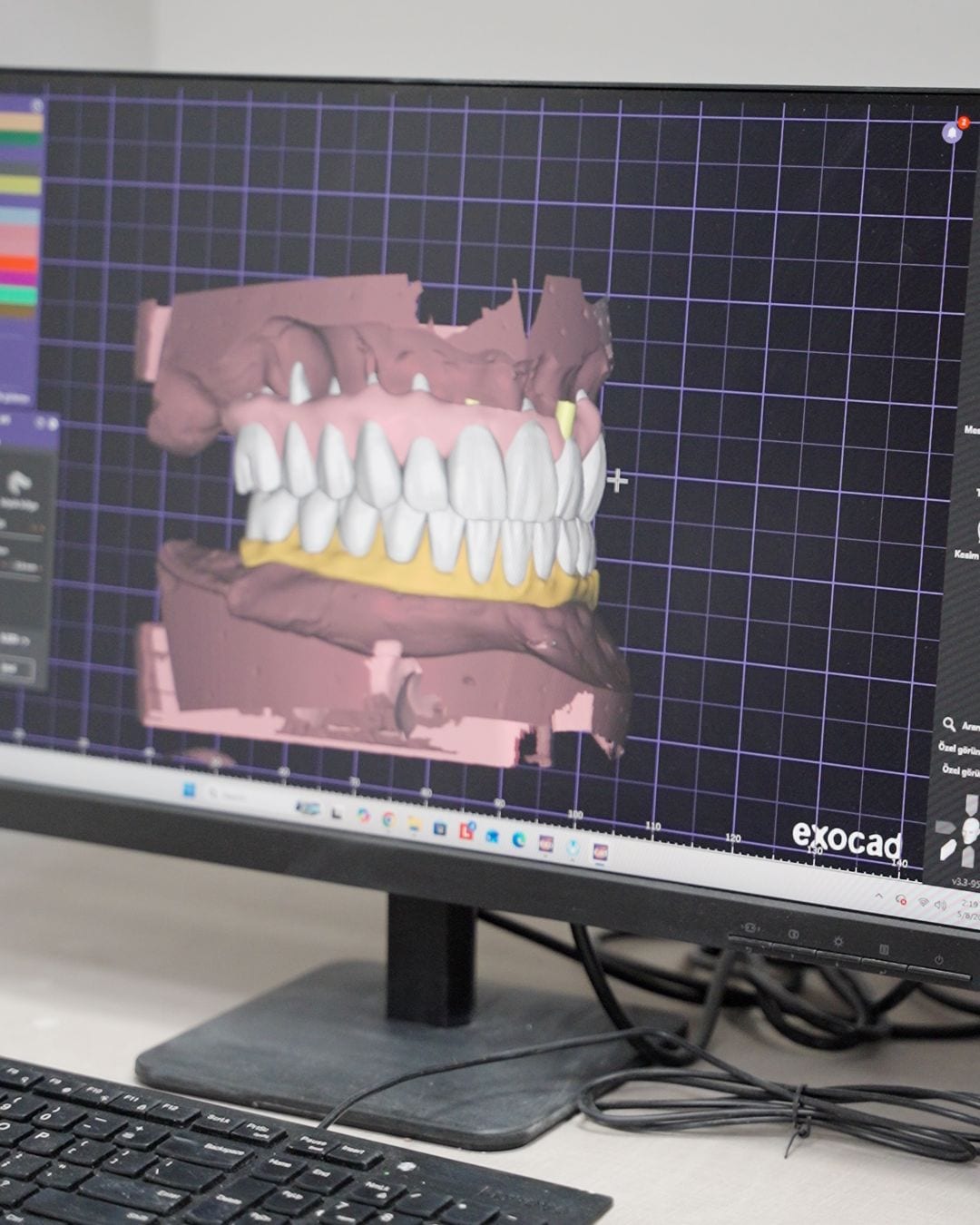
The decision between the two techniques is not made on paper, but based on a precise analysis of your bone. The key tool is the CBCT, a three-dimensional computed tomography scan that shows the height, thickness, and density of the bone in every area of the arch, as well as the position of important structures such as the maxillary sinus and the nerve. Only with these images is it possible to establish whether there is enough room for six implants or whether four implants, taking advantage of tilting, are the safer path.
At Navident you can start even before leaving: a free online consultation reviewing your panoramic X-ray lets us give you initial guidance and a written, fixed quote before you travel, so there are no surprises on arrival. The final plan, with the choice between All-on-4 and All-on-6, is then confirmed at the clinic thanks to CBCT and 3D imaging, always with a written guarantee on the treatment and aftercare via video consultation once you are back home.
No, there is no solution that is better in absolute terms. All-on-6 offers load distribution over more points and greater stability when the bone allows it, but it requires adequate bone conditions to accommodate six implants. All-on-4, thanks to the angled rear implants, often avoids bone grafting and is an excellent choice when the posterior bone is limited. The right solution depends on your bone, your chewing forces, and your goals, and is determined after a CBCT assessment.
In many cases, yes. When bone quality allows, immediate loading is possible, meaning a fixed temporary bridge is fitted right after the implants are placed. The final bridge is made later, once the implants have integrated with the bone. The possibility of immediate loading is assessed case by case based on the stability achieved during surgery.
Usually two trips are needed. The first, about 4-5 days, is dedicated to placing the implants and, when indicated, fitting a temporary bridge. After an osseointegration period of 3-6 months, you return for a second trip of about 5-7 days for the final bridge. Navident arranges the airport transfer and follows up with aftercare via video consultation once you are back home.