If you lost one or more teeth some time ago and have been told there isn't enough bone for an implant, bone grafting Albania is probably the solution you have heard about. When bone volume is missing, placing an implant becomes risky or impossible: the bone must be able to receive the titanium screw and keep it stable. A graft rebuilds that volume and prepares the ground for a long-lasting implant. In this guide we explain why bone shrinks, which materials exist, when a graft is really needed, how long healing takes, and how much you can save by having it done in Tirana.
A bone graft is a procedure that adds volume to your upper or lower jaw when there isn't enough bone to support a dental implant. The graft material acts as a scaffold on which your own body builds new bone, until a solid, stable foundation is formed. It is a well-established bone regeneration technique, performed every day around the world before a great many implant treatments.
The root of a natural tooth stimulates the bone every time you chew. When a tooth is extracted or falls out, that stimulation stops and the bone gradually begins to resorb, meaning it shrinks in height and width. This is a completely normal process called bone resorption, and it is most pronounced in the first months after tooth loss. The more time passes, the more volume can be lost. This is why people who lost teeth years ago often need a graft before an implant, while those who act soon after extraction can sometimes avoid it.
Without sufficient bone density, the implant would lack proper anchorage and the risk of failure would rise. Bone regeneration addresses exactly this problem, making it possible to treat even cases that would otherwise be judged unsuitable for implants.
There is no single type of graft: the choice depends on how much bone needs rebuilding, the area, and your clinical situation. All the materials we use are CE-certified and come from reliable international suppliers. Here are the four main categories.
An autologous graft uses bone taken from your own body, for example from another area of the mouth: it is considered the gold standard for integration but requires a second surgical site. An allograft is bone of human origin, processed and made safe in certified tissue banks. A xenograft comes from an animal source (typically bovine) and is one of the most widely used materials in the world because it integrates very well and creates an excellent scaffold. A synthetic graft, finally, is produced in the laboratory from biocompatible materials such as calcium phosphate and avoids biological sources altogether.
During your consultation we will explain which material is most suitable in your case and why. Different materials are often combined, and in many procedures a membrane is also applied to protect the area and guide the growth of new bone.
Not everyone needs a graft. Many patients have enough bone and can receive implants directly. The need for a graft typically arises in a few recurring situations that are worth knowing about.
It is often needed when a tooth has been missing for many years and the bone has resorbed, when replacing a tooth lost to advanced gum disease, or in the upper back jaw where the maxillary sinus sits too low. In the latter case a sinus lift is used, a technique that gently raises the sinus membrane to add bone height. There is a more modest crestal approach and a lateral-window approach for larger deficits.
The only way to know for sure whether you need a graft is a three-dimensional assessment of the bone. It cannot be determined from a simple photograph or a panoramic image: this is why accurate planning, which we discuss further down, is so important.
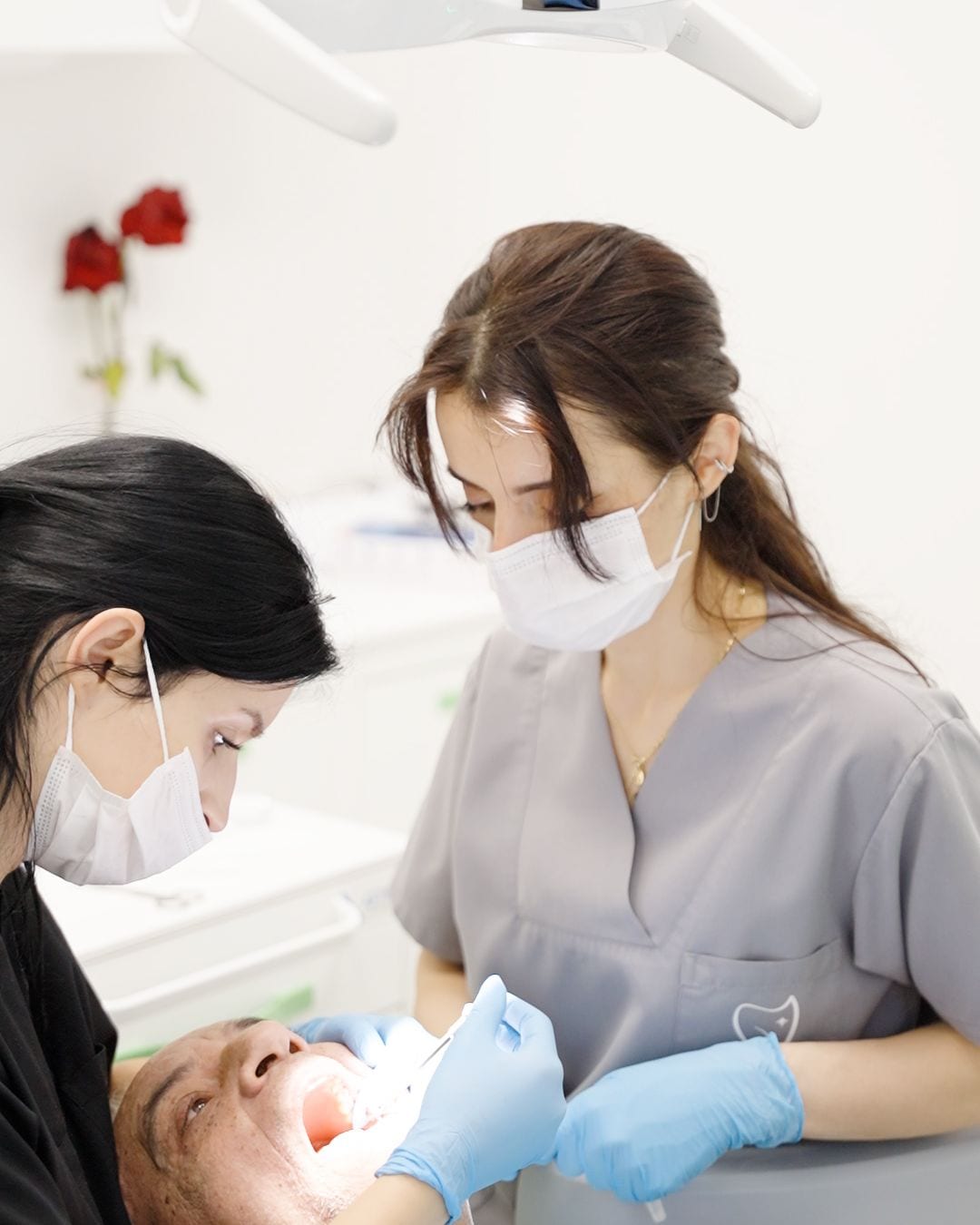
A bone graft procedure is carried out under local anaesthesia and is less invasive than many people imagine. The dentist exposes the area, applies the graft material where volume is missing, protects it with a membrane when needed, and closes with a few stitches. Most patients report discomfort comparable to that of an extraction, manageable with ordinary painkillers.
After the graft a healing period of roughly 3-6 months is needed, during which your body turns the material into new, mature bone that is solid enough to support an implant. The exact length depends on the size of the graft and your own healing capacity. In selected cases, when the deficit is minimal, the graft and the implant can be performed in the same session; more often they are two separate stages. This means that patients who need a graft usually plan more than one trip: returning home during the healing months is entirely normal, and care continues remotely through video consultation.
One of the main advantages of being treated in Tirana is cost. As a guideline, a sinus lift with the crestal technique starts from around €240, a fraction of what you would pay in Italy or the UK for the same procedure and the same materials. In general, at Navident you can save up to 70% compared to Western Europe, with the same standards and the same implant brands.
The lower price does not reflect lower quality. Albania charges no VAT on medical procedures, and the cost of living, rents and salaries is lower: these are the real reasons for the savings. Before you travel you receive a fixed, written quote, so you know exactly what you will spend with no surprises on arrival. When the graft is part of a complete implant treatment, we will give you a clear picture of the total costs, graft and implants included.
The safety of a graft depends almost entirely on the quality of the planning. That is why every case is studied with a CBCT, a cone-beam computed tomography scan that produces a precise three-dimensional image of your bone. The CBCT shows us exactly where volume is missing, where the nerves run, and where the maxillary sinus lies, so we can decide the type of graft, the amount of material and the ideal position of the future implants before we even begin.
Everything starts comfortably from your home. You can send us your panoramic X-ray for a free online consultation: our team reviews it and tells you whether you are likely to need a graft, outlining the next steps. We work only with CE-certified materials, issue a written guarantee on treatments, and after you return home we remain available with post-operative care through video consultation. We also arrange your airport transfer and, with a flight of about one hour from Italy, reaching Tirana is genuinely easy.
It cannot be determined from a simple photo or panoramic image: a three-dimensional CBCT assessment of the bone is needed. You can, however, start for free by sending us your panoramic X-ray for an online consultation: our team will tell you whether you are likely to need a graft and what the next steps are, even before you travel.
Generally about 3-6 months of healing are needed for the material to turn into new, mature bone that is solid enough to support the implant. The exact time depends on the size of the graft. In selected cases with a minimal deficit, the graft and implant can happen in the same session; more often they are two separate stages, which is why two trips are usually planned.
The procedure is done under local anaesthesia and most patients report discomfort comparable to an extraction, manageable with ordinary painkillers. As for cost, a crestal sinus lift starts from around €240: in Albania you can save up to 70% compared to Western Europe, with the same CE-certified materials and standards, and a fixed written quote before you travel.