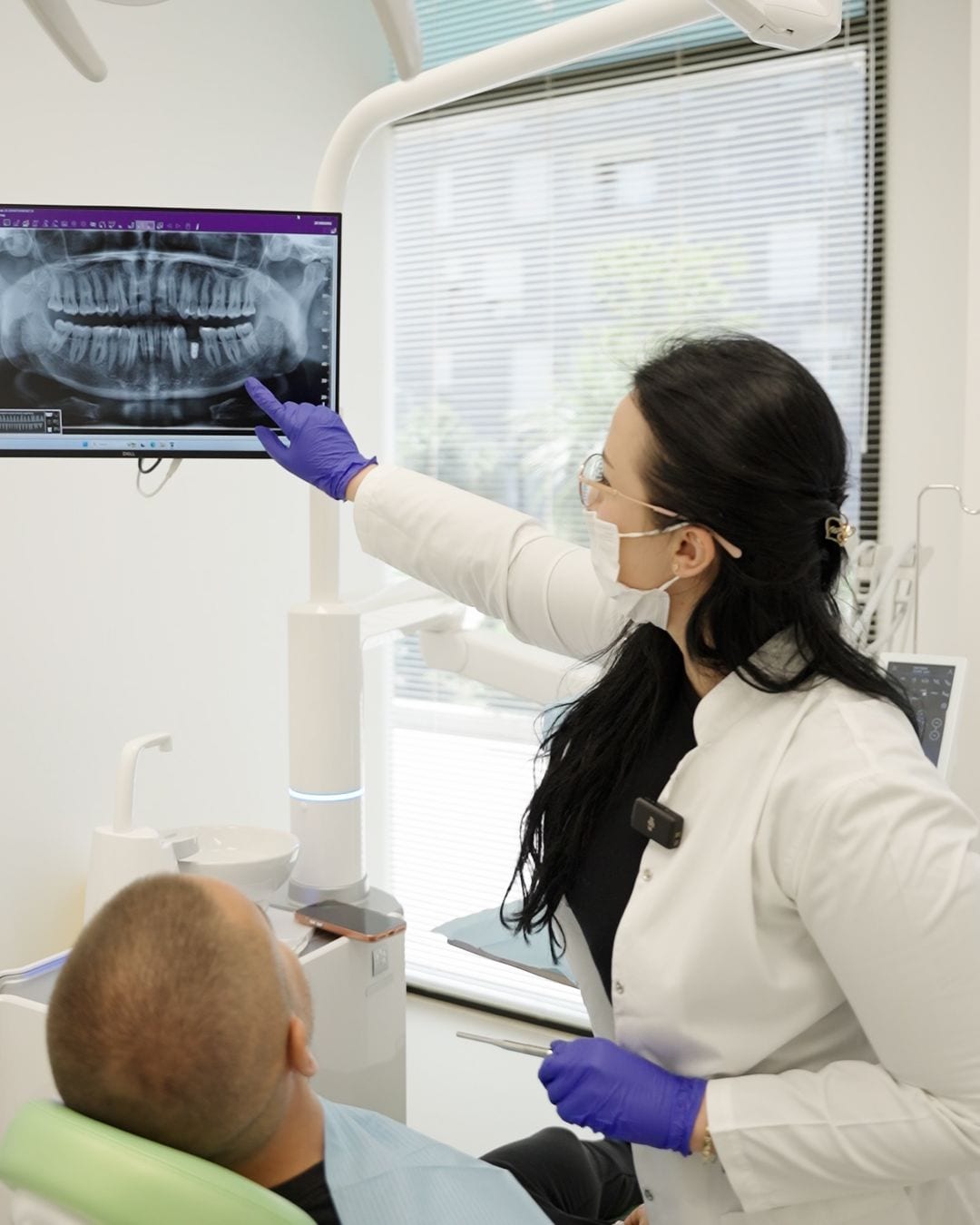
If you have lost a tooth or need to have one extracted, a single implant is today the most stable and long-lasting way to replace it. The cost of a single tooth implant in Albania starts at around EUR 450-800 for the implant alone, and from EUR 800-1,200 with the final crown, with savings of up to 70% compared with Italy, the UK and Western Europe, using the same materials and clinical standards. In this guide we look at what an implant replaces, what is included in the price, how the procedure works, and why it is often the better choice over a traditional bridge.
A single dental implant replaces both the root and the crown of one missing tooth. It is a small, biocompatible titanium screw that is placed into the jawbone and acts as a new artificial root. Once it has integrated, a ceramic crown is fixed on top of it, reproducing the shape and colour of a natural tooth.
Unlike a removable denture or a bridge, the implant is self-supporting: it does not rest on the neighbouring teeth and does not require them to be filed down. This makes it the ideal choice when a single tooth is missing between healthy natural teeth, because it preserves the structure you already have.
In Albania, the price of a single implant starts at around EUR 450-800 for the implant alone, while the complete treatment, implant plus final crown, ranges from EUR 800 to EUR 1,200. In Italy or the UK the same treatment often costs twice or three times as much. The saving comes from economic factors, not from lower quality.
Albania charges no VAT on medical procedures, and the cost of living, rents and salaries is lower. This allows the clinic to offer the same CE-certified implants from leading international brands at a much lower price. Before you travel you always receive a fixed, written quote, so there are no surprises when you arrive.
When you compare quotes it is important to understand what the price covers. At Navident the cost of a single implant includes the examination and planning with 3D imaging, the CE-certified titanium implant, the placement surgery and the post-operative check-ups. The final crown, made in the in-house CAD/CAM laboratory, is normally counted separately and brings the total into the EUR 800-1,200 range.
The service also includes elements that make the trip easier: the free online consultation with a review of your panoramic X-ray before you travel, the airport transfer, and aftercare through video consultation once you are back home. Every implant comes with an implant passport and a written guarantee on the treatment.
The procedure begins with a clinical and radiographic assessment to check the quantity and quality of the bone. If there is enough bone, the implant is placed with a small procedure under local anaesthetic, generally painless and quick. A simple case can be completed in 1-2 days during the first trip.
After placement, the implant needs a period of osseointegration, meaning fusion with the bone, which usually lasts 3 to 6 months. In many cases the final crown is fitted during a second short trip at the end of this phase. If the case is simple and bone conditions allow, in selected situations immediate loading is possible, with a temporary tooth fitted on the same day.
To replace a single tooth, the two main options are an implant and a traditional bridge. A bridge requires the two adjacent teeth to be filed down so they can support a structure that holds the artificial tooth. An implant, by contrast, is self-contained and does not touch the neighbouring teeth, keeping them intact. This is the most important difference: with an implant you do not sacrifice healthy teeth.
An implant also offers a long-term advantage: by stimulating the bone the way a natural root would, it helps prevent the bone resorption that often follows tooth loss. A bridge can be a good solution in specific cases and is quicker, but an implant is generally considered the more conservative and durable option when clinical conditions allow it.
At Navident we use CE-certified implants from leading international brands, including Straumann, Nobel Biocare, MIS and Megagen. These are the same systems used in the best European clinics, ensuring reliability and long-term compatibility. Every patient receives an implant passport documenting the brand and model of the implant placed, which is useful for any future check-up wherever you are.
The crown is chosen according to the position of the tooth. For molars and back teeth, which take heavy chewing loads, zirconia is usually preferred, being very strong at around 1000 MPa. For front teeth, where aesthetics matter most, E-max lithium disilicate offers a more natural translucency. All crowns are made in our in-house CAD/CAM laboratory and are covered by a written guarantee.
If you are considering a single implant and want to know what it would cost in your case, you can send us your panoramic X-ray for a free online consultation: we will review it and tell you whether an implant is the most suitable solution and what to expect, even before you book your trip.
The implant alone starts at around EUR 450-800, while the complete treatment with the final crown ranges from EUR 800 to EUR 1,200. The price depends on the implant brand, the type of crown and the condition of the bone. You always receive a fixed, written quote before you travel, so you know exactly what you will spend.
A simple case can be completed in 1-2 days on the first trip. Usually, though, the implant needs a 3-6 month osseointegration period before the final crown is fitted, which is done during a second short stay. In selected cases a temporary tooth can be placed on the same day.
When clinical conditions allow, an implant is generally preferable because it does not require filing down the neighbouring teeth and preserves the natural structure. It also stimulates the bone and helps prevent resorption. A bridge remains a valid option in specific cases and is quicker, but it sacrifices two healthy teeth.