When a quote for an implant or a crown in Albania comes in 60-70 percent lower than at home, the first reaction is natural: is something wrong here? The short answer is no. The reason why dental work is cheaper in Albania has nothing to do with poor materials or clinical shortcuts, and everything to do with a set of economic and tax factors that lower the clinic's costs, not the quality of care. In this guide we explain the real reasons, one by one, and show you how to verify quality for yourself before you book.
The final price of dental care is made up of two big components: the cost of materials and devices, which is similar across Europe, and the cost of running the clinic, which varies enormously from country to country. A dental implant made by Straumann or Nobel Biocare costs roughly the same in Milan, London or Tirana, because it is the same certified product sold by the same international distributors. What changes is everything else: taxes, rents, salaries and administrative overheads. In Albania these items are structurally lower, and that flows straight through to the quote.
It is important to grasp this distinction, because it dismantles the most common fear. You are not paying less because you receive less: you are paying less because the clinic spends less simply to exist. In the next sections we look at exactly where that gap comes from.
One of the most significant and least understood differences concerns taxation. In Albania, medical procedures, including dental treatment, are not subject to VAT. This means that the tax which, in many European countries, adds substantially to the final price is simply not applied to the cost of your care. It is a genuine, perfectly legitimate saving, written into the country's tax structure, not a promotional discount that disappears after your first appointment.
On its own this factor does not explain the whole price gap, but it is an important piece. When you add the absence of medical VAT to lower operating costs, the overall saving, which can reach up to 70 percent, starts to have a fully transparent explanation.
The second major reason is the cost of living. In Albania, commercial rents, utilities, staff salaries and administrative overheads are significantly lower than in Italy, the United Kingdom or Western Europe. A clinic has to cover these fixed costs before it earns anything, and recovers them through the price of treatment. Where the rent on a unit in the centre of a large Italian city can absorb a huge slice of turnover, in Tirana the same space costs a fraction, and that lowers the price level needed to operate sustainably.
The same applies to qualified staff. Many dentists working in Tirana trained in Italy, Germany or other European universities and have clinical preparation equivalent to that of their Western colleagues, but the cost of labour in the country is lower. The professional value does not change; what changes is the economic context in which that value is offered.
This is the heart of the quality question. A serious clinic in Albania uses the same materials and the same brands you would find in a top-tier clinic in Italy or the United Kingdom. At Navident, for example, implants are CE-certified devices from international brands such as Straumann, Nobel Biocare, MIS and Megagen, accompanied by an implant passport that documents precisely what was placed in your mouth. These are the same titanium implants used across Europe, with the same protocols and the same manufacturer guarantees.
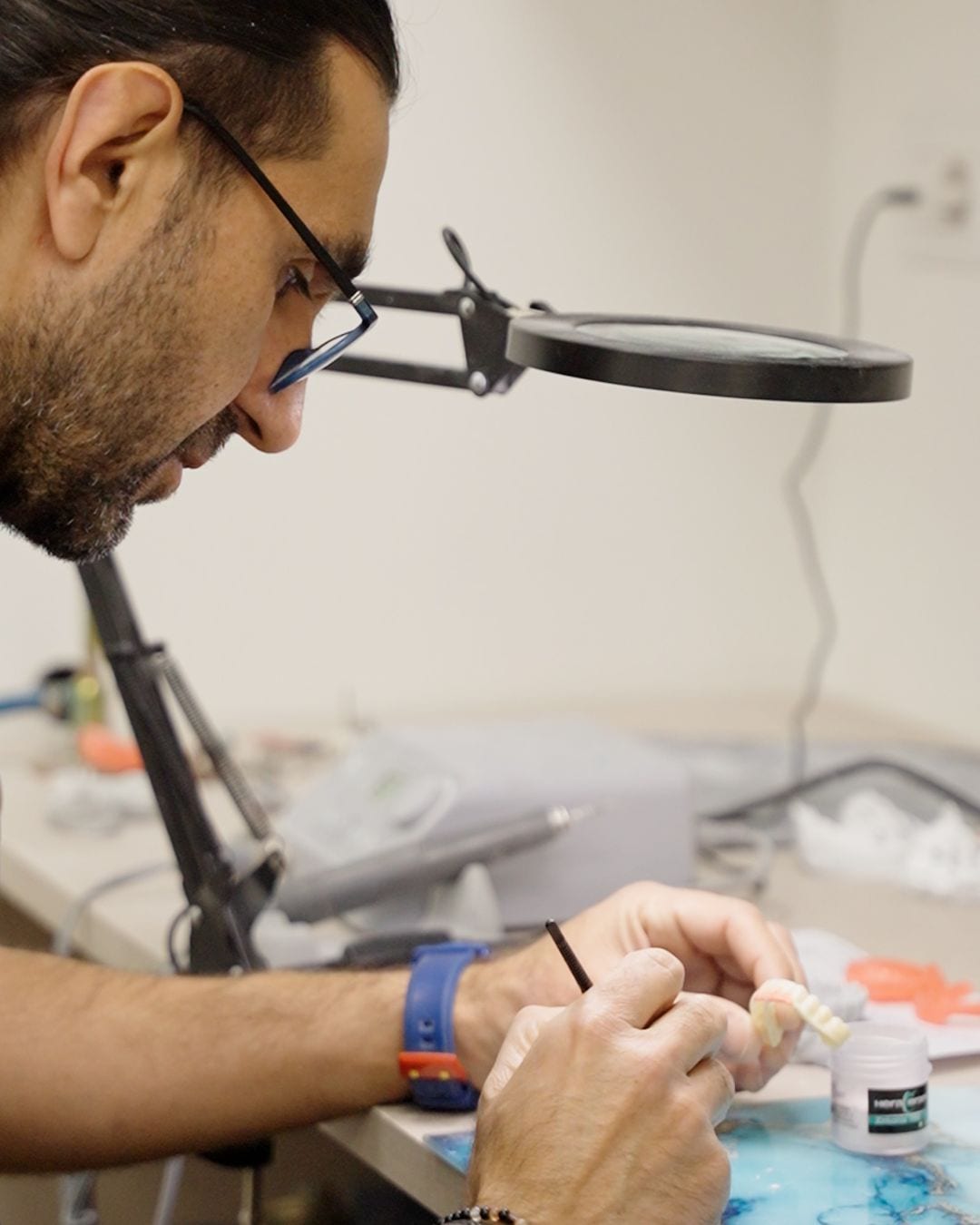
The same principle applies to the visible parts of the work. A zirconia crown, an E-max ceramic veneer or a bridge made in Tirana start from the same ceramic materials as those made in Milan. Zirconia, which is very strong, is the ideal choice for molars, bridges and implant restorations, while E-max, which is more translucent, performs best on front teeth for aesthetic reasons. When the restoration is designed and produced in an in-house CAD/CAM laboratory, with 3D imaging and intraoral scanners, the precision and aesthetics are on par with Western results. The difference in price does not translate into a difference in the product you take home.
As consumers, our instinct often links a high price with high quality, but in dental tourism that equation is misleading. The price of treatment does not measure the dentist's skill or the implant's quality: it measures the sum of the clinic's costs plus its margin. If two clinics use the same Straumann implant, the same CAD/CAM laboratory and dentists with equivalent training, but one operates in a market with far lower taxes and rents, that clinic can offer the same result at a lower price without taking anything away from the patient.
The quality of dental care depends on diagnosis, planning, the clinician's experience, sterility and materials, not on the clinic's postcode. A reliable clinic in Tirana gives you a fixed, written quote before you travel, so you know exactly what you will pay with no surprises on arrival, and a written guarantee on treatments, exactly as you would expect at home. These are the elements on which to judge quality, far more than the number on the quote alone.
You do not have to take anything on trust. Before committing, you can and should verify a few concrete points. Ask which implant brands the clinic uses and whether they provide an implant passport: CE-certified brands such as Straumann, Nobel Biocare, MIS and Megagen are a good sign. Check that you receive a fixed, written quote before you travel and that a written guarantee on treatments is included. Ask about the dentists' training and whether the staff speak Italian or English, so you can communicate without misunderstandings throughout the process.
The simplest way to remove any doubt is to start remotely. At Navident you can request a free online consultation: by sending your panoramic X-ray you receive an assessment and a written quote before you even book the flight, which is about an hour from Italy. That way you can calmly compare materials, timelines and costs with those of your local dentist, and decide with all the information in hand. The saving in Albania is real and transparent, but the right choice always comes from checking it for yourself.
No. The lower price comes from the absence of VAT on medical procedures and from lower operating costs such as rents and salaries, not from poor materials. A serious clinic uses the same CE-certified implants and the same ceramic materials as Western Europe, with dentists often trained in Italy or Germany. Quality depends on diagnosis, experience and materials, not on price.
The saving can reach up to 70 percent compared with prices in Italy, the United Kingdom and Western Europe, for the same materials and standards. For example, a single implant starts from around 450-800 euros and an implant with crown from around 800-1,200 euros. To get a precise figure for your case, it is best to request a written quote by sending your panoramic X-ray.
Ask which implant brands are used and whether they issue an implant passport, insist on a fixed, written quote before you travel and a written guarantee on treatments, and check the dentists' training and that the staff speak Italian or English. The safest way to start is a free online consultation: by sending your panoramic X-ray you receive an assessment and a quote before you even travel.